A softgel production line is a set of connected machines that turns gelatin and a liquid fill into dried, inspected softgel capsules. Three units are essential: gelatin melting, encapsulation and drying. Whether you also need medicine preparation, sorting, cleaning and packaging units depends on your product and your business model. This guide explains what each unit does, which ones you can skip, and what to decide before you buy.
Key takeaways
- Gelatin melting, encapsulation and drying are essential. Medicine preparation, color mixing, sorting and packaging depend on your product.
- Gelatin melting tanks range from 60 L to 2000 L. Smaller tanks are usually heated electrically, larger ones by circulating hot water.
- Final drying can be done on trays, in tumble dryers, or in intelligent tumble dryers with built-in dehumidification.
- A small R&D machine suits test batches and first projects. A large fully automatic machine suits large-scale production.
1. What Is a Softgel Production Line?
A softgel production line is an automated line made up of several units. In practice the softgels move through the line in this order:
- Gelatin melting and medicine preparation: the gelatin solution and the fill are prepared.
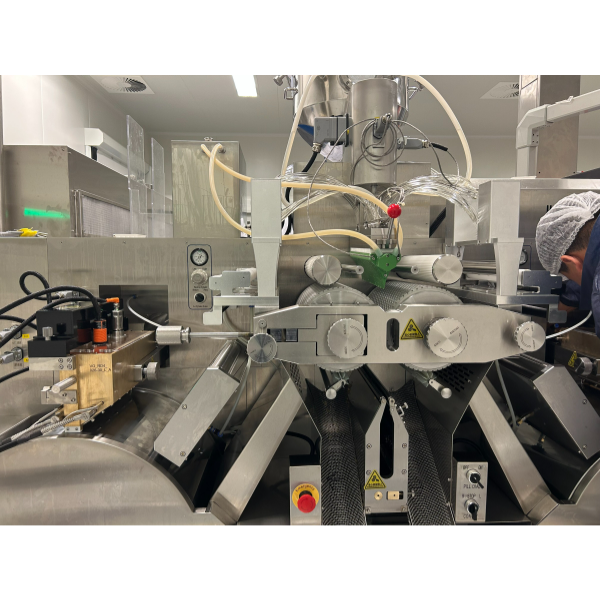
- Encapsulation: the gelatin ribbons are formed on the casting drums, the fill is injected between two ribbons, and the rotating die rollers press, seal and cut the capsules.
- Shaping and initial drying: freshly made softgels are tumbled so they hold their shape.
- Final drying: softgels are dried on trays or in tumble dryers.
- Sorting and cleaning: unqualified softgels are removed and surface oil is cleaned off.
- Packaging: qualified softgels are packed, labeled and stacked.
The die roller sets installed on the encapsulation machine decide the shape and size of the softgels. For the process parameters at each stage, such as temperatures, ribbon thickness and moisture, read our guide to the softgel capsule making process.
2. What Equipment Does the Softgel Production Line Include?
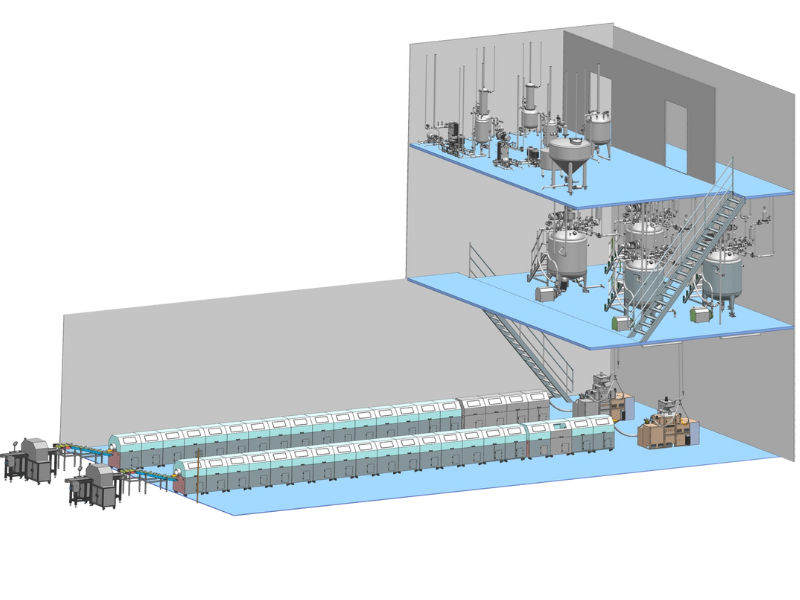
A softgel production line is not one piece of equipment. It consists of many production units and many single machines. The full line includes:
- Gelatin melting and medicine preparation system
- Softgel encapsulation system
- Softgel drying system
- Sorting system
- Cleaning system
- Packaging system
The gelatin melting system, the encapsulation system and the drying system are essential units. Without any one of them, softgel production cannot be completed. The other units depend on your own circumstances:
| Unit | Essential? | When you can skip it |
|---|---|---|
| Gelatin melting system | Essential | Never |
| Softgel encapsulation system | Essential | Never |
| Softgel drying system | Essential | Never |
| Medicine preparation system | Depends on your fill | Your product is an oil that does not need to be stirred, heated or mixed in advance |
| Gelatin color mixer | Depends on your product | You make transparent softgels only |
| Sorting system | Depends on your output and quality | Your output is relatively small, your product quality is high, and softgels can be packaged directly after drying |
| Packaging system (blister packing, bottling) | Depends on your business | You do OEM processing and ship all softgels in large batches to the customer’s factory |
Gelatin Melting System
The gelatin melting system consists of gelatin melting tanks (gel melters), hot water tanks, gelatin service tanks (gel tanks) and gelatin color mixers.
Gelatin melting tank. It is also called a gelatin melter. It melts gelatin granules into a gelatin solution. The tank has a heating jacket and a mixer, so the granules melt with water while being heated and mixed. Manufacturers can choose the tank size by production capacity: 60 L, 100 L, 200 L, 300 L, 400 L, 500 L, 600 L, 800 L, 1000 L, 1200 L, 1500 L or 2000 L. Depending on the size, the tank is heated electrically or with hot water. For smaller tanks, electric heating is faster and more convenient. For large tanks, hot water circulation is faster and more suitable because it keeps the temperature even and stable.
Hot water tank. It supplies hot water to the heating jacket of the gelatin melting tank, and it is not needed when the melters are electrically heated. A hot water circulating pump moves the hot water between the melting tank and the hot water tank. Hot water tanks are usually electrically heated. Some softgel manufacturers need gas heating, and we can modify the tank to a client’s special requirements. The hot water tank, hot water circulation pump, vacuum pump and vacuum condenser together are called the gelatin melting supporting unit.
Gelatin color mixer. It is also called a gelatin coloring machine. It mixes the colorant or pigment evenly into the melted gelatin solution. You do not need it if you make transparent softgels only.
Gelatin service tank. It is also called a gelatin tank or gel tank. It stores the gelatin solution once the solution is ready in the melting tank. The filled service tank is moved to the encapsulation room and connected to the softgel machine, and compressed air pushes the gelatin out of the tank and on to the machine for production.
Medicine Preparation System
The softgel fill preparation system consists of medicine mixing tanks and medicine service tanks. The medicine (or fill) that can be encapsulated into softgels must be an oil, an oily suspension or an oily paste. The medicine preparation tanks mix the fill with the oil until it is even and smooth. For large softgel production, closed medicine mixing tanks with the same structure as the gelatin melting tank are needed, so the medicine and oil can be sucked into the tank automatically, and the finished medicine liquid can be transferred to the medicine service tanks (fill tanks) automatically by compressed air.
Softgel Encapsulation System
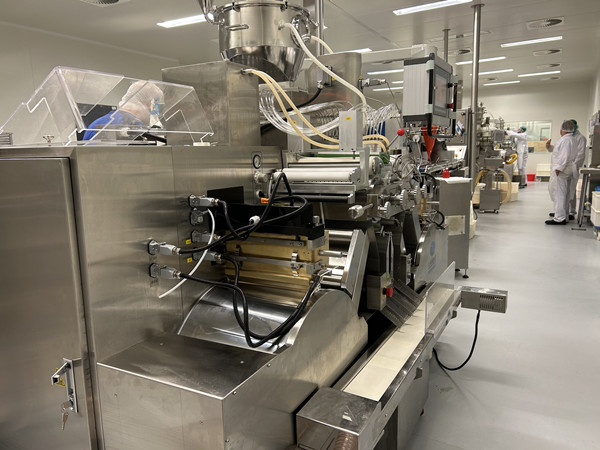
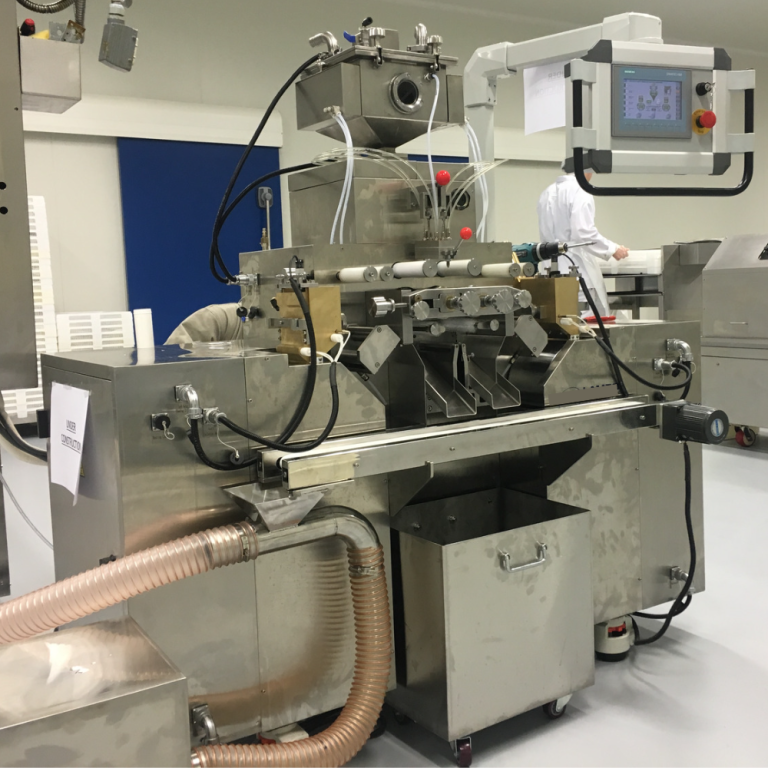
The encapsulation system is the core system of the whole line, because the softgels are formed here. It consists of the softgel encapsulation machine and the softgel shaping and initial drying tumble dryers.
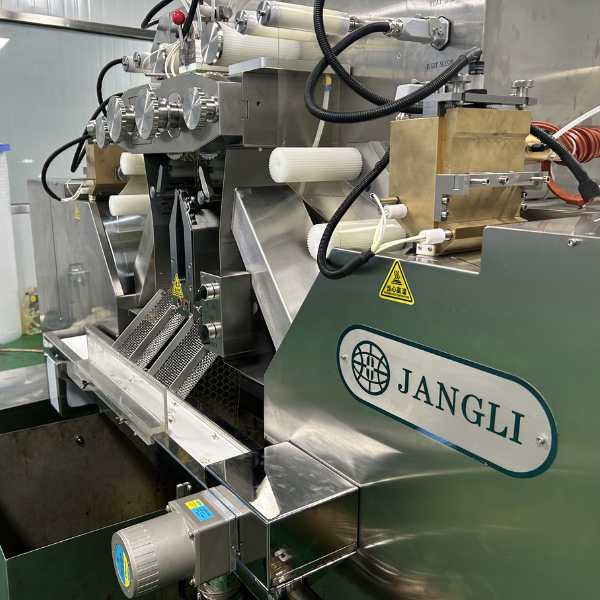
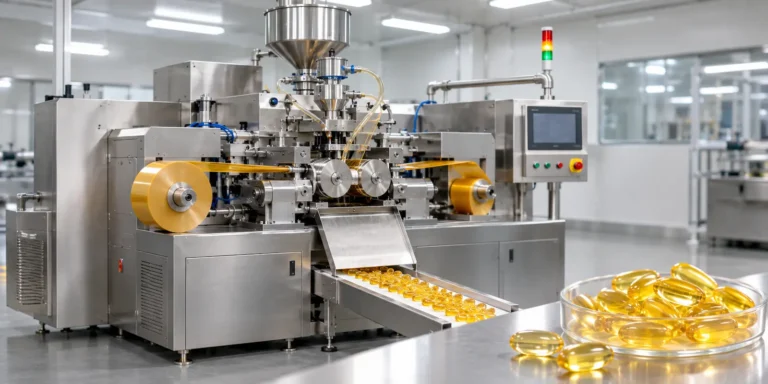
Softgel encapsulation machine. It turns the gelatin solution into gelatin ribbons on the casting drums, injects the fill between the two ribbons, and forms capsules by pressing them with the die roller sets installed on the machine. The die roller sets decide the shape and size of the softgels. By designing the die roller cavities, we can make capsules round, oblong, oval, twist, fish, heart, star or any animal shape. To see how a die roller is built, read our softgel die roller guide. Softgel machines come in different sizes, and manufacturers choose according to their production capacity requirements.
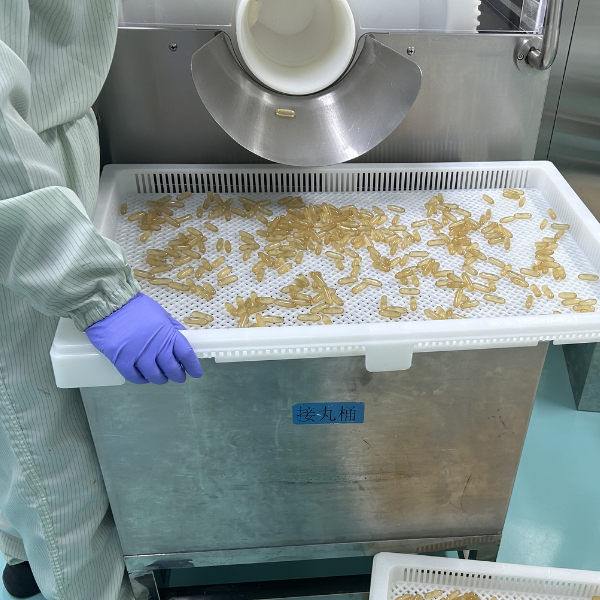
Softgel shaping and initial drying tumble dryer. Softgels that have just been encapsulated and dropped from the machine are soft and fragile, and they deform or break easily. Rotating tumble dryers help them take shape and begin drying. A motor turns the cage, the cage turns the softgels inside, and air blown through the cage cools the softgels and reduces the moisture on their surface. This sets the shape and stops the softgels from sticking to each other, which would affect product quality and appearance.
Softgel Final Drying System
After shaping and initial drying, the softgels are strong enough for the next step, final drying. Traditionally there are two methods: tray drying and inline tumble dryer drying. Both need a low-temperature, low-humidity environment, so the softgel drying room should have a dehumidifier and an air conditioner, with the room temperature controlled to about 19°C and the relative humidity to 20%.
In recent years JANGLI has developed a new drying method, the intelligent tumble dryer system. It is tumble dryer drying with a built-in air conditioning and dehumidification system, so the temperature and relative humidity can be controlled inside the closed baskets.
Softgel tray drying. After initial drying, the softgels can be spread flat on softgel drying trays to dry. JANGLI’s drying trays are made of food grade “PP” in the original, and have small holes so air passes through easily. The trays are stackable to save space, and the stacked trays go on matching trolleys. Each trolley takes 33 trays. The trays need a drying room with the temperature controlled to 19°C and the relative humidity to 20%, and the softgels must be turned over by hand at regular intervals so they do not deform.
Softgel tumble dryer drying. Tray drying needs a lot of space and labor and takes a long time, and the softgels are prone to sticking and deformation. We therefore recommend inline tumble dryers for final drying. The drum keeps the softgels rotating during drying, which prevents sticking and deformation from pressure. It also saves labor and helps keep drying consistent. JANGLI’s double deck tumble dryers save floor space.
Intelligent tumble dryer. With JANGLI’s intelligent tumble dryer, manufacturers do not need a special drying room or room-level temperature and humidity control. The built-in dehumidifier keeps removing moisture from the softgels and supplies dry air, so no special drying room is needed and floor space is saved.
Sorting, Cleaning and Packaging
Sorting. Sorting removes unqualified softgels from the dried batch, such as oversized and undersized capsules, flat capsules, bubble capsules and irregularly shaped capsules. It can be done by hand on a light inspection table, or with automatic softgel inspection and sorting equipment, which detects and kicks out softgels with bad shapes, sizes or colors.
Cleaning. Lubricating oil is left on the surface of the softgels during encapsulation. An oil-absorbing cloth added to the drying cage helps clean it off. See Softgel Oil-Absorbing Cloth for Softgel Production for details.
Packaging. The packaging system packs, labels and stacks the qualified softgels. Blister packing machines and bottling lines are the usual choices, depending on how you sell your product.
3. How to Choose the Right Softgel Production Line for Your Business?
First decide what stage your softgel project is at and how much you need to produce. If you have just entered the softgel industry, want to start with small batches and your production demand is not high, we recommend an R&D softgel encapsulation machine. This small machine can be used for testing and developing new products and for formal production of small batches. It is also suitable for learning how to use and operate softgel equipment without wasting a lot of raw material.
If you are new to the industry but already have many potential customers and a large demand for softgels, or you already have some softgel equipment and need to expand, we recommend a large fully automatic softgel machine. This kind of machine has high output, a high degree of automation and good stability. It saves labor, time and raw material and allows large-scale production.
Seven Things to Decide Before You Buy
- Target output. Check the output table below for the model, capsule shape and size you need.
- Capsule shape and size. The die roller sets decide both, so tell us the shapes and sizes you need before you choose a machine.
- Fill type. Softgels are filled with oils, oily suspensions or oily pastes. A dry powder fill is not suitable for a softgel line.
- Shell type. Decide between an animal gelatin shell and a plant-based shell. For the starch option, see our tapioca starch softgel machine guide.
- Drying method. Tray drying, tumble dryer drying or intelligent tumble dryer drying. Your available space, labor, and whether you want a controlled drying room all affect this choice.
- Which units you need. Use the table in section 2 to see which optional units apply to your product and business model.
- Space and utilities. The line uses compressed air (to push the gelatin and fill out of their tanks), a vacuum pump and condenser, and hot water or electric heating. If you use tray or standard tumble drying, you also need a drying room with a dehumidifier and an air conditioner. Ask us for the utility requirements of the model you choose.
If your project needs validation, IQ/OQ/PQ documentation is available on request.
Output per Hour by Model, Capsule Shape and Size
The table below lists output per hour at the rotating speed shown for each model. Please confirm the figures with us before ordering.
| Shape | Size | JL-100II (4 rpm) | JL-150III (5 rpm) | JL-250II (4 rpm) | JL-250III (6 rpm) | JL-300III (6 rpm) |
|---|---|---|---|---|---|---|
| Oval | 6# | 24,000 | 86,100 | 140,400 | 210,600 | 333,870 |
| Oval | 8# | 22,800 | 63,000 | 120,960 | 181,440 | 287,640 |
| Oval | 10# | 17,280 | 61,200 | 106,080 | 159,120 | 252,260 |
| Oval | 14# | 15,360 | 48,000 | 92,160 | 138,240 | 219,150 |
| Oval | 16# | 15,360 | 46,500 | 81,840 | 122,760 | 194,610 |
| Oblong | 8# | 15,840 | 49,200 | 100,800 | 147,600 | 233,990 |
| Oblong | 10# | 14,400 | 48,000 | 98,400 | 126,000 | 199,760 |
| Oblong | 16# | 13,680 | 32,400 | 84,000 | 88,200 | 139,820 |
| Oblong | 20# | 8,160 | 30,600 | 58,800 | 99,360 | 157,510 |
| Oblong | 22# | 7,200 | 41,400 | – | – | – |
| Round | 38# | 9,120 | 28,800 | 66,240 | 88,200 | 139,820 |
| Tube | 20# | 4,800 | 86,100 | 58,800 | 58,800 | 93,210 |
Send us your capsule shape, fill and target output and we will recommend a model.
Frequently Asked Questions About Softgel Production Lines
Which units are essential in a softgel production line?
The gelatin melting system, the encapsulation system and the drying system. Without any one of them, softgel production cannot be completed. Medicine preparation, color mixing, sorting and packaging depend on your product and business, as shown in the table in section 2.
Do I need a medicine preparation system?
Not if your product is an oil that does not need to be stirred, heated or mixed in advance. For large softgel production, closed medicine mixing tanks are needed so the medicine and oil can be sucked in and the finished liquid transferred to the medicine service tanks automatically by compressed air.
Which drying method should I choose for softgels?
Tray drying needs a lot of space and labor, takes a long time, and the softgels must be turned by hand. Tumble dryers keep the softgels rotating, which prevents sticking and deformation. An intelligent tumble dryer adds built-in air conditioning and dehumidification, so no special drying room is needed.
What machine should a startup begin with?
An R&D softgel machine is the usual starting point for testing new products, producing small batches and learning to operate softgel equipment. If you already have many potential customers and large demand, a large fully automatic softgel machine is the better fit.
Related guides
- Softgel capsule making process and precautions: temperatures, ribbon thickness and moisture at each stage
- How to equip your softgel production line: essential components and machinery
- Types of softgel encapsulation machines by capacity
- Lecithin softgel production: how to prevent leakage during storage
- The role of softgel encapsulation machines in the nutraceutical industry
Written by Wendy Yu, JANGLI. Last reviewed: [2026]. Specifications and output figures may change, please confirm with us before ordering.