


How to Plan Softgel Fill Preparation
Medicine preparation means preparing the fill, the material inside the capsule, so that it is heated, mixed and ready for the encapsulation machine to dose. Choose equipment by batch size, by how the material must be mixed, and by how it will move to the machine.
Which Equipment Covers Which Job
| Equipment | Typical job | Published details |
|---|---|---|
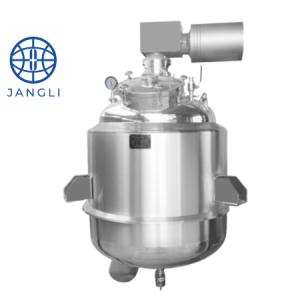
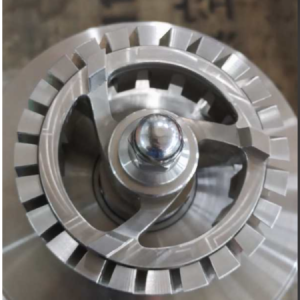
| Medicine Preparation Tank | Larger fill batches with homogenizing | Triple-layer tank (inner tank, hot-water jacket, insulation). Vacuum feeding and pressure discharging. Slow frame stirrer plus a high-speed bottom homogenizer. Listed sizes: 600, 1,000 and 2,000 L (480, 800 and 1,600 L effective). |
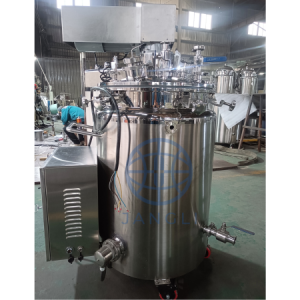
| One-pot Medicine Preparation Tank | Vacuum mixing with high-shear homogenizing | Mixing under vacuum, hydraulically lifted cover, a fast homogenizing stirrer plus a slow scraping stirrer. Homogenizing speed 0–2,800 rpm (VFD control). Optional PLC control. See the product page for sizes. |
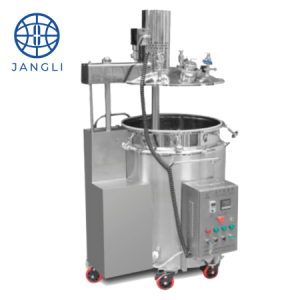
| Mobile Medicine Mixing Tank (JLSY series) | Smaller batches, moved between stations | Triple-wall water-jacketed tank with a low-speed frame agitator. Hydraulic lifting of the mixing assembly for cleaning. Braked polyurethane casters and side-wall discharge. Listed volumes: 100, 200 and 300 L; working pressure 0–0.08 MPa. |
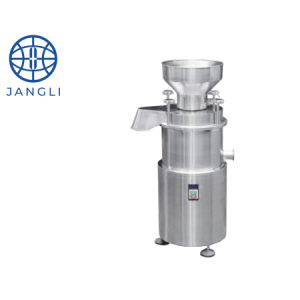
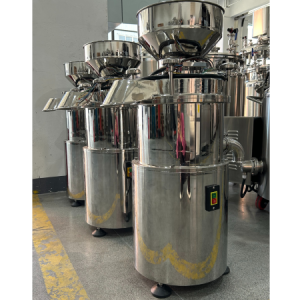
| Softgel Medicine Recycling Machine (DGN series) | Recovering fill from rejected capsules | Cuts and crushes capsules, then separates the fill by centrifuge; the gelatin shell leaves through a separate waste port. Listed capacity 60 kg/h and recycle rate of 90% or higher. 1.1 kW, 380 V, 50 Hz. |
What to Include in Your Inquiry
To compare proposals on a consistent basis, include the following in your inquiry:
- Your fill material and formulation, and whether it needs high-shear homogenizing or vacuum feeding.
- Required usable batch size and daily encapsulation demand.
- How the fill will reach the encapsulation machine, and your installation layout.
- Available utilities, such as hot water, compressed air, vacuum and power supply.
- Cleaning requirements and, if you need fill recovery, how much rejected product you expect.
Keep Fill Preparation Separate from Shell Preparation
This category covers equipment for the material inside the capsule. For the capsule shell, see the gelatin preparation system and define how both areas will supply the encapsulation line.
Related Guides
For mixing in practice, read fish oil production with a focus on the ingredients mixing process. For the whole line, see how to equip a softgel production line.
Medicine Preparation System FAQ
How do I choose between the fill preparation tanks?
Start with batch size, then mixing needs. The Medicine Preparation Tank is listed at 600–2,000 L with a bottom homogenizer and vacuum feeding. The one-pot tank adds vacuum mixing, a hydraulic cover and high-shear homogenizing. The mobile JLSY tank is listed at 100–300 L and can be moved on casters. Send us your batch size and formulation and we will recommend one.
Does my fill need a high-shear homogenizer?
It depends on the formulation. The product pages describe the homogenizer as breaking down agglomerates and reducing particle size, and list it on the Medicine Preparation Tank and the one-pot tank. The mobile JLSY tank is described with a frame agitator only. Tell us your fill material and the texture you need and we will confirm which configuration fits.
How does the prepared fill reach the encapsulation machine?
According to the Medicine Preparation Tank page, clean compressed air can push the finished material out through the bottom outlet to the holding tank or feed pump of the softgel machine. The mobile JLSY tank discharges from the side wall and can be rolled next to the machine. Your layout decides the best route, so include it in your inquiry.
Can fill be recovered from rejected capsules?
The DGN recycling machine cuts and crushes capsules and separates the fill by centrifuge, while the gelatin shell leaves through a separate waste port. The page lists 60 kg/h and a recycle rate of 90% or higher. Whether recovered fill can be reused depends on your own quality requirements. For the gelatin film mesh, see the mesh gelatin film recycling machine.
Can a gelatin melting tank also prepare fill?
Do not assume so. The two stages prepare different materials with different requirements, so specify each separately. Gelatin melting equipment is covered in the gelatin preparation system category. Tell us your fill and shell materials and we will propose the equipment for each stage.