


Lecithin softgels leak during storage mainly because lecithin is hygroscopic and draws moisture from the gelatin shell, which weakens the shell and seams. Four production changes reduce the problem: optimized gelatin melting, a thicker shell with redesigned dies, multi-stage humidity-controlled drying, and strict process discipline with automation.
Lecithin is a phospholipid found in cell membranes and widely used as a functional health supplement. It emulsifies fats and supports cardiovascular health, which makes it a popular softgel fill. After extensive collaboration with manufacturers and repeated technical refinements, we have identified four core improvements that make lecithin softgel production more stable over the long term.
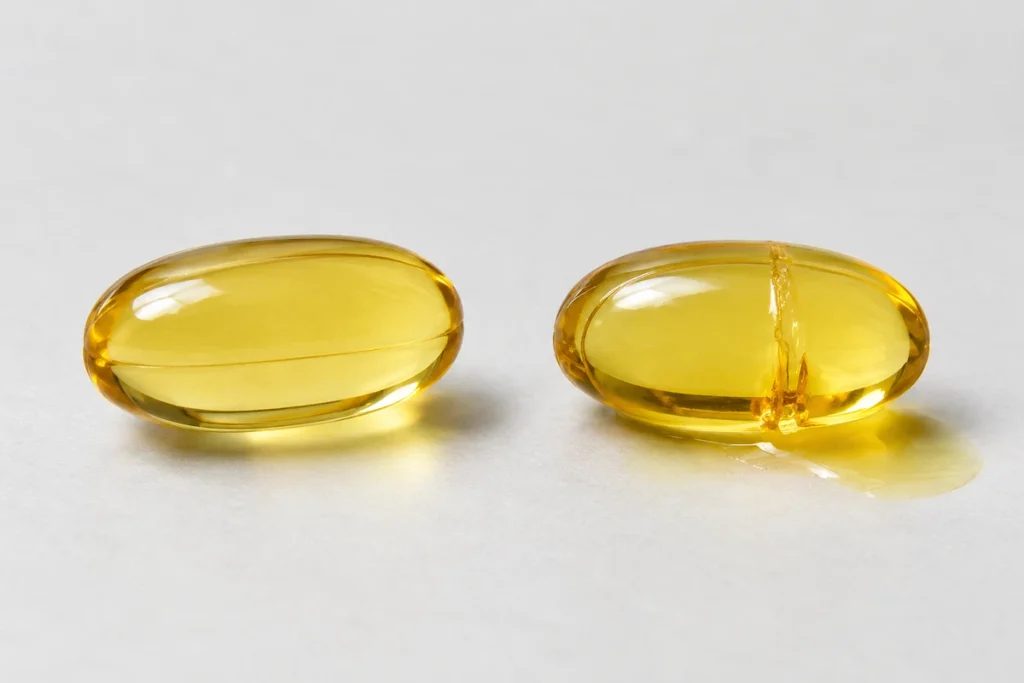
Why Do Lecithin Softgels Leak?
Lecithin is hygroscopic. In storage, the fill absorbs moisture from the gelatin shell, so the shell and the seams gradually weaken. Three production factors make this worse:
- Weak upper seams: standard die roller designs leave the upper seam as the weak point.
- Uneven seam formation: uneven heating at the injection wedge produces inconsistent seams.
- Incomplete or uneven drying: internal moisture and hygroscopic activity continue after the capsules are packed.
Lecithin Softgel Production Parameters at a Glance
| Stage | Parameter | Recommended setting |
|---|---|---|
| Gelatin | Type and Bloom strength | Bone-derived gelatin, Bloom 180–200 |
| Gelatin melting | Melting temperature | About 65°C |
| Gelatin melting | Gelatin-to-water ratio | Adjusted from the traditional formula to suit lecithin fills |
| Gelatin melting | Holding time | Use immediately; do not let it sit overnight in holding tanks |
| Encapsulation | Shell thickness | 0.8–0.9 mm (standard softgels: 0.7–0.8 mm) |
| Setting drying | Tumble dryer speed and load | 15–20 rpm, 50% capacity or less, at least 40 minutes |
| Humidity drying | Relative humidity (RH) | 26%, 24%, 22% for 4 hours each, then 20% |
| Final result | Moisture content | 8% or below |
Optimize Gelatin Selection and Melting
- Choose high-quality gelatin: use bone-derived gelatin with a Bloom strength of 180–200 for better seam integrity. Keep the melting temperature controlled at about 65°C to preserve the gelatin properties.
- Adjust the formula: move away from the traditional gelatin-to-water ratio and fine-tune it for lecithin fills, so that the shell resists moisture migration.
- Process in time: do not let molten gelatin sit overnight in holding tanks. Using it right after melting keeps the fluidity optimal and reduces premature moisture loss.
A closed, controlled gelatin preparation system makes it easier to keep the melting temperature and timing consistent.
Improve Encapsulation: Shell, Die Roller and Injection Wedge
- Thicker gelatin shells: adjust the shell thickness to 0.8–0.9 mm, compared with 0.7–0.8 mm for standard softgels, to improve seam strength and resist leakage.
- Customized die roller design: redesigned die rollers with expanded upper cutting surfaces address leakage at the weak upper seams and stabilize the gelatin during sealing.
- Uniform heating with a wide injection wedge: a wider, straight injection wedge distributes heat evenly, which is critical for consistent seam formation.
- Gentle setting drying: after encapsulation, use a slow tumble dryer (15–20 rpm) loaded to 50% capacity or less to minimize mechanical stress, and extend the setting drying to at least 40 minutes so the seams cure properly.
Lecithin is a thick fill, and for thick fills we generally recommend double-step die rollers over single-step ones, because the extra step makes the seam stronger and less likely to leak. Read more in our guide to softgel die rollers.
Dry Lecithin Softgels With Multi-Stage Humidity Control
Lecithin softgels need balanced humidity during drying. Drying that is too aggressive hardens the surface while moisture stays inside, and that retained moisture later causes leakage. Our recommended intelligent dehumidifying tumble dryer offers programmable, multi-stage humidity control. Run the stages in this order:
- Setting drying: tumble slowly at 15–20 rpm with the dryer loaded to 50% capacity or less, for at least 40 minutes.
- Phase 1: 26% relative humidity for 4 hours.
- Phase 2: 24% relative humidity for 4 hours.
- Phase 3: 22% relative humidity for 4 hours.
- Final phase: 20% relative humidity until the moisture content of the softgels reaches 8% or below.
This gradual approach dries the capsules uniformly and reduces the leakage caused by internal hygroscopic activity after storage. The JL-250III high speed softgel machine is also available with an integrated dehumidifying tumble dryer line.
Keep the Process Disciplined and Automated
Strictly follow timed gelatin processing, die roller maintenance and automated humidity control to minimize human error. In our experience with production partners, these changes noticeably reduce leakage in lecithin softgels. For die roller care, see how to maintain softgel die rollers and prevent corrosion.
By combining material selection, precision tooling and smart drying, lecithin softgel manufacturers can deliver stable, high-quality products at scale.
Lecithin Softgel FAQ
Why do lecithin softgels leak during storage?
Lecithin is hygroscopic, so the fill absorbs moisture from the gelatin shell during storage. This weakens the shell and the seams. Weak upper seams, uneven heating at the injection wedge and incomplete drying, which leaves moisture inside the capsule, all make leakage more likely.
How can I reduce leakage in lecithin softgels?
Four changes help: optimize gelatin selection and melting, use a thicker shell with redesigned die rollers and a wide injection wedge, dry the softgels with multi-stage humidity control, and keep the process disciplined and automated to reduce human error.
What gelatin should I use for lecithin softgels?
Use bone-derived gelatin with a Bloom strength of 180-200 for better seam integrity, and melt it at about 65°C. Use the molten gelatin immediately rather than letting it sit overnight in holding tanks, so that fluidity stays optimal and moisture is not lost prematurely.
How thick should the shell of a lecithin softgel be?
A shell thickness of 0.8-0.9 mm is recommended for lecithin softgels, compared with 0.7-0.8 mm for standard softgels. The thicker shell improves seam strength and helps resist leakage.
What drying humidity settings suit lecithin softgels?
After a slow setting drying of at least 40 minutes at 15-20 rpm and 50% capacity or less, use a dehumidifying tumble dryer in stages: 26% relative humidity for 4 hours, 24% for 4 hours, 22% for 4 hours, then 20% until the moisture content of the softgels is 8% or below.
Which die roller works best for lecithin softgels?
Lecithin is a thick fill, so a double-step die roller is recommended instead of a single-step one, because the extra step makes the seam stronger and less likely to leak. Die rollers with expanded upper cutting surfaces also address leakage at the weak upper seams.
Written by the JANGLI technical team (WUXI JANGLI MACHINERY CO., LTD., softgel equipment manufacturer since 1996). Last reviewed: October 2026. Parameters depend on your formula, machine and plant conditions, so please validate them in your own trials or contact us for advice.
Need Help With Lecithin Softgel Production?
Tell us about your formula, machine and leakage problem, and our engineers will recommend the right die rollers, drying system and process settings.


